



Wisconsin Builds the Autonomous Fleet.
The Great Lakes are about to become the proving ground for America’s autonomous and maritime future. Wisconsin sits at the center of it — with the shipyards, the airspace, the industrial base, the workforce, and the research anchors to lead.
A paradigm shift is already underway.
As demonstrated in Ukraine, Iran, and across emerging theaters, the tools and art of warfare are being fundamentally rewritten. Autonomous systems are no longer a future capability — they are a present reality reshaping how air, ground, naval, and maritime operations are conceived and executed.
The naval and maritime dimensions of this shift are only beginning. Bolting autonomous payloads onto legacy hull designs is not enough. The fleets of the future must be natively autonomous, demanding a ground-up rethinking of platform design, production strategy, and industrial base alignment.
And the same technologies are dual-use: the autonomous vessels, sensors, and AI built for defense also serve commercial shipping, port security, environmental monitoring, and Great Lakes freshwater research — widening the market and the payoff for the region that builds them.
The United States is investing hundreds of billions to onshore production of autonomous, maritime, microelectronics, energy, and advanced manufacturing capability. The question is where it gets built.
The Midwest Defense Accelerator (MDX), a non-profit subsidiary of the Sagamore Institute, calls this region the Autonomous Heartland. Wisconsin’s answer to that call is the strongest in the Great Lakes.
A manufacturing state, ready to pivot.
Manufacturing is the single largest sector of Wisconsin’s economy — a deep, skilled industrial base that can transition into autonomous and maritime production faster than almost anywhere in the country.
Sources: Wisconsin Manufacturers & Commerce (2024–25); Lightcast / Visual Capitalist manufacturing-jobs-per-capita data (2025).
A conversation between Fincantieri Marine Group CEO George Moutafis and Office of Management and Budget shipbuilding chief Jerry Hendrix at the Midwest Defense Summit in June 2026.
Lake Michigan is the Navy’s “Area 52.”
In U.S. Naval Institute Proceedings, Capt. Jerry Hendrix, USN (Ret.) — now Chief of the OMB Shipbuilding Office in the Trump administration — argued the Navy needs a secure range to develop and test unmanned and autonomous systems, away from adversary surveillance, just as the Air Force built Area 51. His answer: Lake Michigan.
Testing breakthrough capabilities in front of the world — in the Caribbean, the Arabian Gulf, or the Pacific — invites the same espionage that compressed Soviet nuclear and missile timelines a generation ago. Whoever masters not just the platforms but the concepts of operations for autonomy will hold a decisive, sustainable advantage. That edge has to be developed where competitors cannot watch.
Lake Michigan is uniquely suited: the only Great Lake entirely within U.S. territory, large and deep enough for surface and subsurface testing, with existing FAA-designated restricted military airspace overhead.
- Restricted airspace R‑6903 — already flown by Air National Guard aircraft from the four adjoining states, including Wisconsin.
- Autonomy is already on the water — the U.S. Coast Guard Great Lakes District is operating a fleet of Saildrone Voyager uncrewed surface vessels across the lakes through October 2026.
- Proven surface operations — the Navy has run sea trials in and around Green Bay for more than a decade.
- A guarded coastline — U.S. Coast Guard Sector Lake Michigan and the 128th Air Refueling Wing at General Mitchell ANG Base, Milwaukee, anchor the lake’s western shore.
- Depth & scale — ~300 miles long, with basins deep enough for unmanned underwater development.
- A regional Navy anchor — NSWC Crane in southern Indiana, one of the Navy’s premier centers for electronic warfare, sensors, and unmanned systems, anchors the broader Midwest autonomous corridor a day’s drive south.
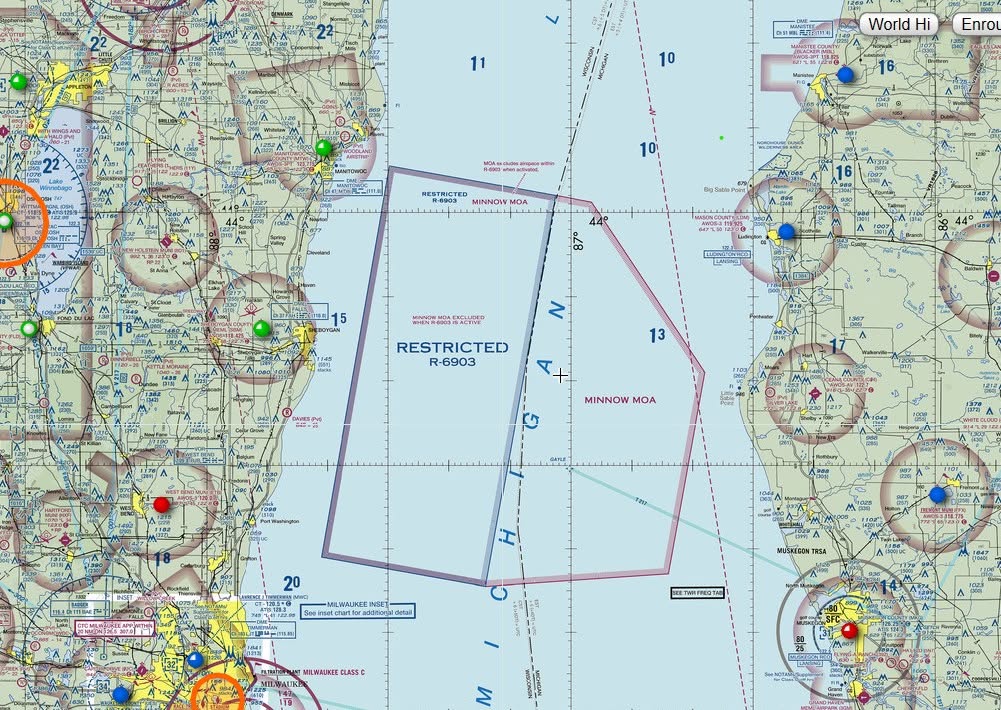
Restricted airspace R‑6903 over Lake Michigan — the FAA-designated military airspace that makes the lake a ready-made, secure test range.
Concept after Capt. Jerry Hendrix, USN (Ret.), “The Navy Needs an ‘Area 52,’” USNI Proceedings, June 2023. Hendrix, a former Sagamore Institute senior fellow, now serves as Chief of the OMB Shipbuilding Office.
Saildrone Spectre — the 170-foot autonomous surface vessel Fincantieri will build in Wisconsin. Watch on YouTube · video courtesy Saildrone.
The assets are already on station.
A Wisconsin corridor — anchored at UW–Madison and Truax Field, reaching north to the Green Bay and Marinette shipyards and out to the Lake Michigan test box — integrates shipyards, airfields, a guarded coastline, a deep supply base, and the Universities of Wisconsin into one autonomous-native ecosystem.
Wisconsin Shipyards
More than $800M invested across Fincantieri’s Marinette Marine, Bay Shipbuilding, and ACE Marine — a surface-combatant center of excellence and a vital pillar of the U.S. maritime industrial base. On Lake Superior, Fraser Shipyards adds full-service Great Lakes new-build, conversion, and repair capacity. It is already going autonomous-native: in April 2026 Fincantieri announced it will build Saildrone’s Spectre — a 170-foot anti-submarine-warfare and strike USV — in its Wisconsin shipyards.
Airfields, Airspace & a Guarded Coast
The 115th Fighter Wing at Truax flies the F‑35A — only the second Air National Guard wing to do so. Volk Field CRTC offers one of the nation’s most capable training airspace complexes; Fort McCoy is the Midwest’s premier total-force training installation; the 128th Air Refueling Wing at General Mitchell ANG Base in Milwaukee extends reach; and U.S. Coast Guard Sector Lake Michigan secures the lakefront.
Universities & a Venture Engine
UW–Madison anchors a top-tier portfolio in advanced manufacturing, robotics & controls, AI, materials, and cybersecurity — plus the Wisconsin Quantum Institute and a world-ranked fusion energy program (the WHAM device and spinoffs Realta Fusion and SHINE Technologies). Across the Universities of Wisconsin, UW–Milwaukee adds R1 research and freshwater & engineering depth; UW–Stout Polytechnic brings applied polytechnic manufacturing; UW–Whitewater contributes business, logistics, and cyber; and UW–Green Bay sits at the doorstep of the shipyards. In Green Bay, TitletownTech, an innovation and investment firm formed by the Green Bay Packers and Microsoft, backs advanced manufacturing startups and operates the AI Co-Innovation Lab in partnership with UW–Milwaukee. They also host the annual Midwest Defense Forum, which brings Heartland and national industry leaders and policymakers together to accelerate defense innovation.
A Pivot-Ready Supply Base
8,700+ manufacturers with deep strength in industrial machinery, precision metalwork, and navigational & control instruments — exactly the disciplines that autonomous and maritime production draws on. These are the same shops that already machine, weld, and assemble to exacting tolerances for aerospace, automotive, and heavy equipment; retooling them for unmanned vessels, sensors, and autonomy hardware is an evolution, not a leap. Statewide, Wisconsin Manufacturers & Commerce represents that base, and its Wisconsin Defense Industry Council is organizing manufacturers to compete for defense work. The Wisconsin Technology Council connects innovators, investors, and policymakers, while the Wisconsin Procurement Institute helps companies navigate and win government contracts. The workforce and the tooling are already here.
Five domains, one operating model.
MDX’s industrial-zone model wraps coordinated, hands-on support around the manufacturers with the greatest potential to transition into autonomous and maritime production — de-risking the move and scaling output.
Manufacturing
Modernizing factory floors, meeting quality standards, and scaling up production.
Defense
Navigating government contracting, finding opportunities, and forming partnerships to win work.
Innovation
Tapping federal research grants and licensing university technology into new products.
Security
Meeting cybersecurity rules and standing up secure, clearance-ready facilities.
Workforce
Building talent pipelines from K–12 and technical colleges to veterans and the Guard.
Wisconsin’s industrial zone is designed to qualify as a Maritime Prosperity Zone — a concept advanced in the proposed SHIPS for America Act and the White House Maritime Action Plan (Feb. 2026), which calls for designating such zones across the Great Lakes and is pending in Congress.
Jobs, growth, and technology that works twice.
A Wisconsin corridor is not only a national-security play — it is an engine for good jobs, new investment, and homegrown companies whose products serve commercial markets as readily as the fleet.
Careers, Not Just Contracts
Building autonomous vessels, sensors, and AI systems creates skilled, family-supporting jobs — welders, machinists, electricians, software and systems engineers — and clear pathways into them from the Wisconsin Technical College System, the Universities of Wisconsin, apprenticeships, and the Guard and Reserve. It gives Wisconsin graduates and veterans a reason to build their careers here.
Federal Investment, Anchored Locally
The hundreds of billions flowing into autonomous, maritime, and advanced manufacturing can land in Wisconsin rather than pass it by. New defense work anchors investment in existing plants, draws suppliers into the region, and multiplies through local economies — turning the state’s industrial base into a durable, higher-value growth engine.
Technology That Works Twice
The same platforms have civilian lives: uncrewed vessels for commercial shipping and port security, sensors and AI for Great Lakes freshwater science and environmental monitoring, and autonomy for agriculture, logistics, and infrastructure inspection. Dual-use widens the market, de-risks the investment, and keeps Wisconsin companies competitive well beyond any single defense program.
The Autonomous Heartland needs a Wisconsin corridor.
The shipyards, the restricted airspace, the research universities, and the manufacturing base do not exist in this combination anywhere else in the Great Lakes. Connecting them — Madison, Milwaukee, Green Bay, and Marinette, out to the Lake Michigan test range — turns scattered assets into a national capability, and into Wisconsin jobs, investment, and dual-use industries that outlast any single program. Wisconsin should lead it.
Help build the Autonomous Heartland in Wisconsin.
Manufacturers, researchers, investors, and partners who want to be part of Wisconsin’s autonomous and maritime future are invited to reach out.
Start on September 6, 2026 — Labor Day weekend, as Notre Dame meets Wisconsin at Lambeau Field — when Sagamore/MDX, UW–Madison, and TitletownTech convene the Autonomous Heartland Forum to lay out the Area 52 proposal, the Great Lakes test corridor, and Wisconsin’s role in building the autonomous fleet.
Autonomous Heartland Forum · Sep 6 Email info@wisecurity.org